Saifullah: Evaluating a Stylish Arabic Calligraphy Font for Design Projects
When selecting typography for projects that require an authentic Arabian aesthetic, designers often face the challenge of balancing traditional artistic integrity with modern digital usability. Saifullah emerges as a notable option in this niche, offering a stylistic interpretation of Arabic calligraphy that emphasizes elegant curves and intricate details. This article provides an objective evaluation of Saifullah, exploring its technical features, design characteristics, and practical applications to help you determine if it aligns with your specific design goals.
Understanding the Design Aesthetic
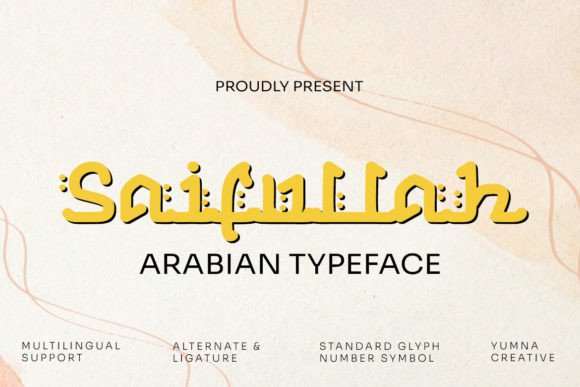
Saifullah is designed to capture the inherent beauty of classical Arabic script. Unlike geometric or modern sans-serif Arabic fonts, Saifullah leans heavily into the organic flow of traditional calligraphy. The font features smooth, sweeping curves and detailed terminal points that mimic the stroke variations created by a traditional reed pen, or qalam. This attention to detail gives text a sense of movement and sophistication, making it suitable for designs that aim to evoke heritage, luxury, or cultural depth.
The visual weight of Saifullah is generally balanced, ensuring that it remains legible while maintaining its decorative appeal. It is not merely a display font; its structure allows for use in shorter body text contexts, such as invitations, headers, or branding elements, where the personality of the typeface can shine without overwhelming the reader. For designers seeking a "classic Arabian look," Saifullah provides a ready-made solution that avoids the sterile feel of some digitized traditional scripts.
Technical Features and Usability
One of the most significant technical advantages of Saifullah is its PUA (Private Use Area) encoding. In the context of Arabic typography, this feature is crucial for accessibility and ease of use. Arabic script relies heavily on contextual ligatures—where letters change shape depending on their position in a word—and additional decorative glyphs that enhance the calligraphic effect.
Without PUA encoding, accessing these special characters often requires complex keystroke combinations or specific software workarounds. With Saifullah’s PUA implementation, users can access amazing glyphs and ligatures with ease through standard character maps or glyph panels in design software like Adobe Illustrator, Photoshop, or InDesign. This reduces the learning curve for designers who may not be experts in Arabic typography but still require professional-grade results. It ensures that the intricate details promised by the font’s design are readily available without technical friction.
Ideal Use Cases
Saifullah is particularly well-suited for projects where visual impact and cultural resonance are prioritized over high-volume readability. Consider using this font in the following scenarios:
- Branding and Logotypes: For businesses in the hospitality, fashion, or luxury goods sectors targeting Middle Eastern markets, Saifullah can convey elegance and tradition.
- Event Stationery: Wedding invitations, gala programs, and ceremonial certificates benefit from the font’s sophisticated curves and formal tone.
- Packaging Design: Products such as perfumes, dates, teas, or artisanal foods can use Saifullah to highlight authenticity and premium quality.
- Cultural Publications: Book covers, magazine headers, or exhibition posters related to Arab history, art, or literature can leverage the font’s classical aesthetic to set the appropriate mood.
In these contexts, the font acts as a visual anchor, immediately signaling the cultural context and tonal quality of the content. Its ability to bring a touch of tradition and sophistication makes it a strong candidate for any design that needs to feel established and refined.
Tradeoffs and Considerations
While Saifullah offers significant aesthetic benefits, it is essential to consider its limitations to ensure it fits your project requirements. As a calligraphic style, it may not be the best choice for extended body text in digital interfaces or small-print documents. The intricate details that make it beautiful at larger sizes can become cluttered or difficult to read when scaled down significantly. Designers should test legibility at various sizes before committing to it for primary reading material.
Additionally, because Saifullah has a distinct personality, it may clash with ultra-modern or minimalist design systems that rely on neutral, invisible typography. If your project requires a stark, contemporary look, a more geometric Arabic font might be a better fit. Saifullah demands space and attention; it is not a background element. Therefore, it works best when paired with ample white space and complementary, simpler typefaces for secondary information.
Comparing Alternatives
When evaluating Saifullah, it is helpful to compare it with other categories of Arabic fonts. If your primary goal is maximum legibility for user interfaces or long-form articles, consider modern Naskh-style fonts that prioritize clarity over decorative flourish. These alternatives may lack the ornate charm of Saifullah but offer superior readability on screens.
Conversely, if you need a highly experimental or abstract look, you might explore Kufic-inspired fonts, which are based on angular, geometric structures rather than the cursive flow of Saifullah. Kufic styles convey strength and modernity, whereas Saifullah conveys grace and tradition. Understanding this distinction helps in selecting the right tool for the emotional response you wish to evoke.
Making the Decision
To determine if Saifullah is the right choice for your project, ask yourself the following questions:
- Does my project require a traditional or luxurious aesthetic? If yes, Saifullah’s elegant curves align well with this goal.
- Will the text be displayed at a size where details are visible? Ensure the font will be used in headers, titles, or short phrases rather than dense paragraphs.
- Do I need easy access to ligatures and glyphs? The PUA encoding of Saifullah simplifies the design process, making it a practical choice for designers who want professional results without technical hurdles.
- Is the target audience culturally connected to Arabic heritage? The font’s authenticity can resonate deeply with audiences who appreciate traditional calligraphic arts.
If your answers lean toward yes, Saifullah is likely a strong fit. It bridges the gap between artistic tradition and digital convenience, offering a reliable way to incorporate sophisticated Arabic calligraphy into modern design workflows. However, always conduct visual tests within your specific layout to ensure harmony with other design elements. By carefully considering the context, scale, and technical needs of your project, you can leverage Saifullah to create compelling, culturally rich visuals that stand out.